
Nestled against the imposing Monts de Vaucluse, the village of Rustrel reveals Provençal charm with a captivating history. From its pre-Roman oppidum to its 17th-century castle, including a mysterious former military nuclear facility converted into an underground scientific laboratory, the town boasts an incredibly rich history spanning a thousand years. But Rustrel is just as captivating for its enchanting natural setting, epitomized by the legendary “Colorado Provençal,” whose ochre cliffs blaze in the sun. From the toponymic trails of the Grande Montagne to the old quarries, set out to discover an exceptional heritage where history, nature, and spectacular landscapes come together.
When History Shapes Provence: The Extraordinary Fate of Rustrel
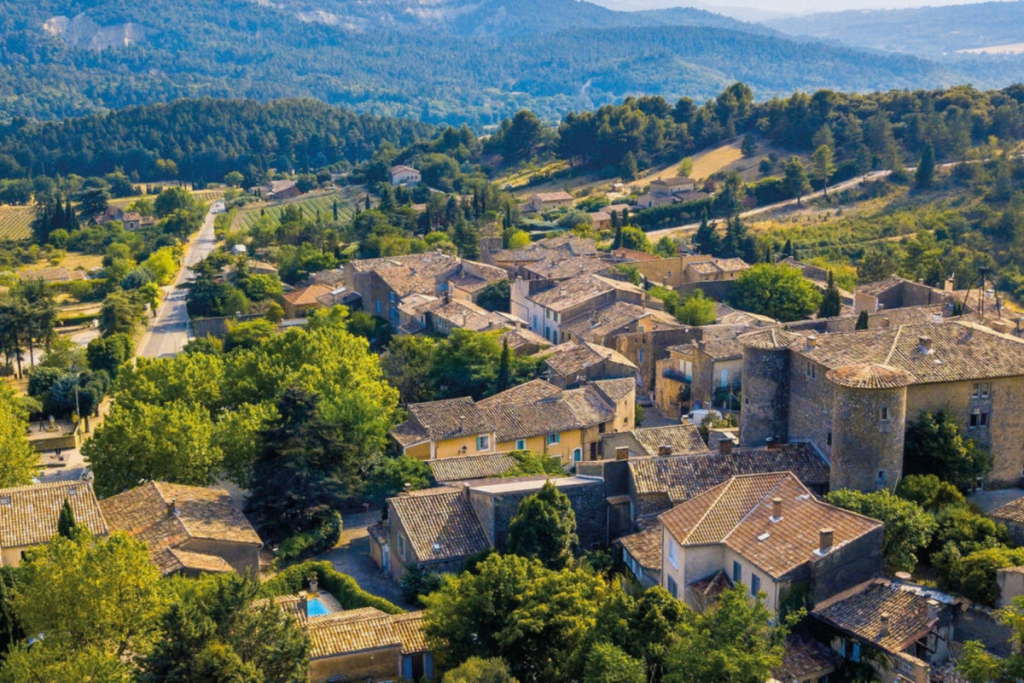
Inhabited as early as the Neolithic period and later home to a vast pre-Roman oppidum on the Pointu massif, the territory of Rustrel has endured through the centuries while constantly reinventing itself. Devastated at the end of the 14th century, the village center was rebuilt around iconic monuments. Its 17th-century castle-town hall bears witness to the noble lords who ruled here in succession before it was purchased by the municipality. Along the “water trail,” visitors can discover a remarkable heritage, including a Romanesque church, an 18th-century oil mill, the Marquise’s washhouse, and charming centuries-old fountains.
But Rustrel’s past also holds more contemporary and unusual adventures. In the 19th century, iron ore mining and charcoal production fueled the local economy for several decades. Later, the Grand Combe was home to the Plateau d’Albion nuclear test site, buried beneath several kilometers of rock. Decommissioned in 1995, the site was converted into the Low-Noise Underground Laboratory, where scientists from around the world now study seismology, astrophysics, and hydrology.
The Colorado Provençal: a marvelous natural landscape of ochre and mountains
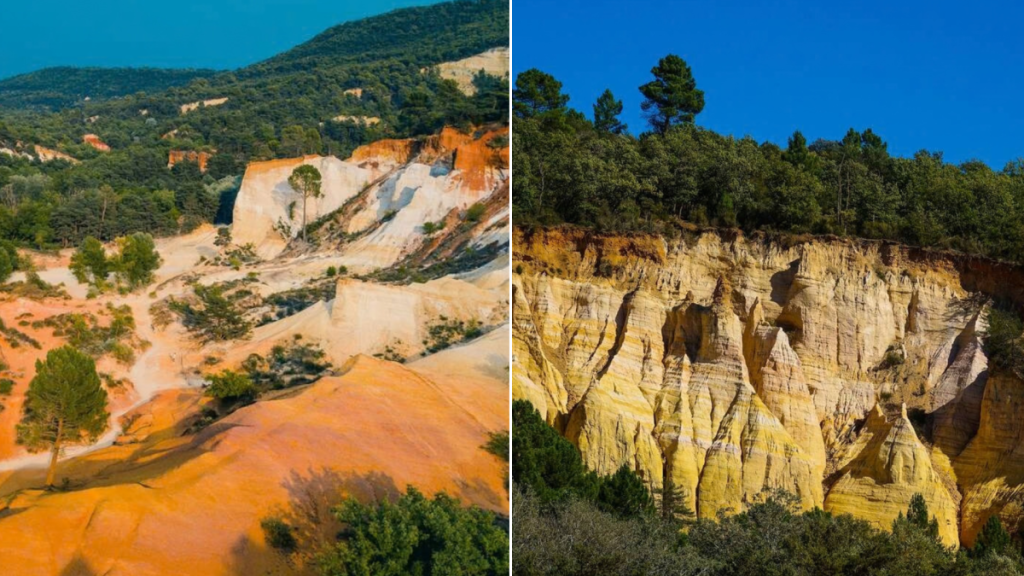
The town of Rustrel flourishes in a spectacular natural setting. This is where the famous Colorado Provençal unfolds—a site designated as a natural monument where tropical geology and the work of ochre miners have shapeddazzling cliffs in shades of yellow, orange, and red. Today, this enchanting landscape can be explored along marked trails, revealing vegetation that has adapted remarkably well to its environment. Below, the cultivated Doa Valley adds a touch of lush greenery, winding its way through vineyards, olive groves, and orchards.
For hiking enthusiasts and lovers of the great outdoors, the region offers an exceptional playground for exploration. To the northeast, the Sentier de la Baume de Midi pays a vibrant tribute to the production methods of yesteryear, while offering a striking panorama of the ochre massif from its interpretive overlook. Further north, the two toponymic trails of the Grande Montagne allow you to uncover the soul of the site. With its industrial heritage, preserved biodiversity, and breathtaking views, Rustrel promises an unforgettable experience just 1 hour and 30 minutes from Marseille.